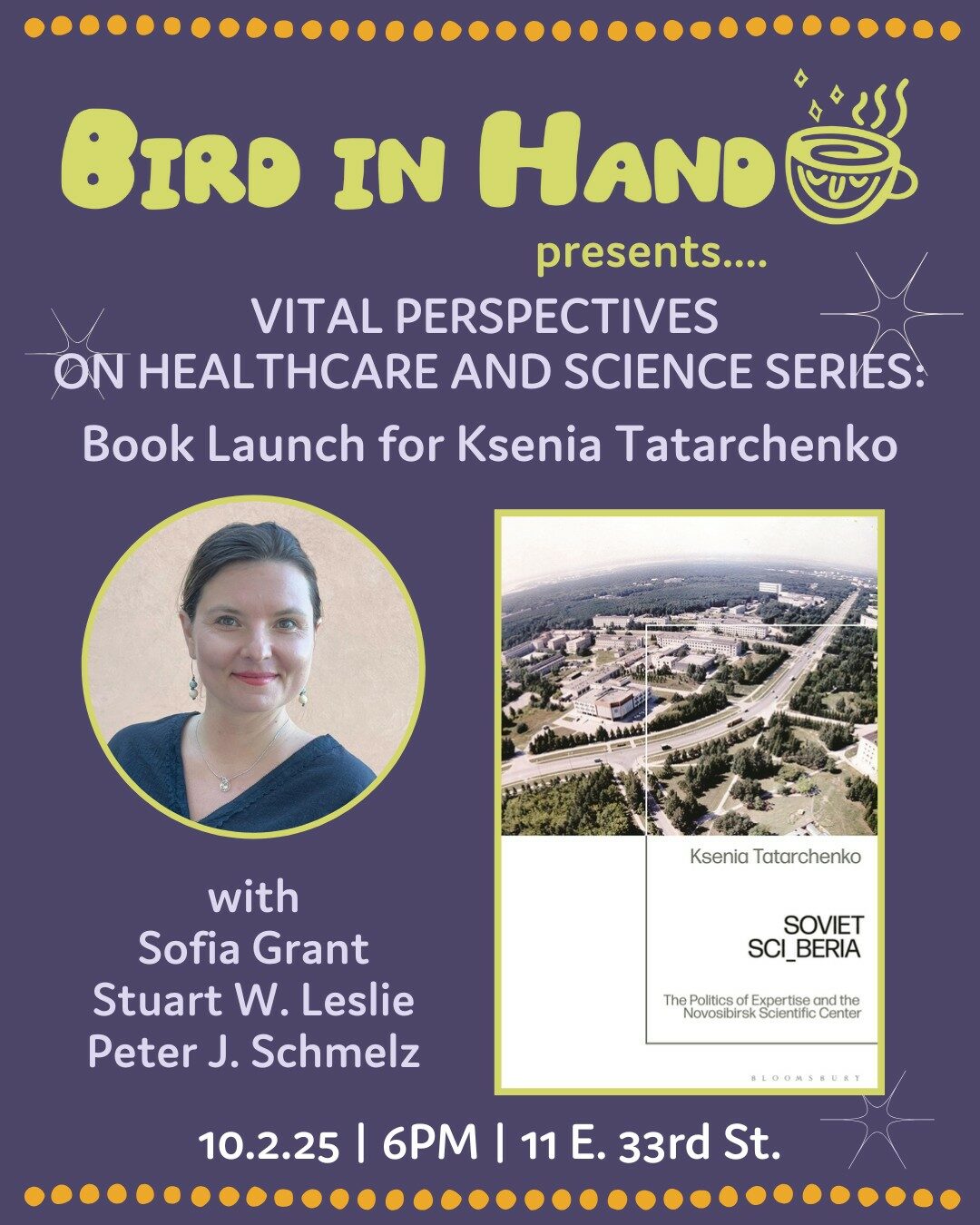
The Vital Perspectives on Healthcare and Science series engages with some of the most pressing public health issues of our time, in a regular public forum catalyzed by a book.
For the October event, we are delighted to welcome Dr. Ksenia Tatarchenko to share her new book Soviet SCI_BERIA: The Novosibirsk Science Center and the Late Soviet Politics of Expertise! It focuses on the Novosibirsk Scientific Center, or Akademgorodok, which at first glance, appears as an outlier in academic excellence. This ‘science city’ is renowned for a preeminent university, dozens of research institutes, and a thriving technopark. At home, it is an emblem of Russian innovation; abroad, it is often portrayed as a potential threat, a breeding ground of cyber soldiers. Soviet SCI_BERIA not only fosters a conversation between history, area studies, and science studies but also sheds new light on Soviet modernity and the limits of its transformative projects.
Fellow historians Sofia Grant, Stuart W. Leslie, and Peter J. Schmelz will join Tatarchenko in conversation.
This event is open to the public, and we encourage you to come even if it’s your first time joining for this event series!
RSVP here!
Order SOVIET SCI_BERIA here
Since 2025, Ksenia Tatarchenko has been teaching in the Medicine, Science, and the Humanities program at Johns Hopkins University. Previously, she held positions as an assistant professor of science and technology studies at the College of Integrative Studies at Singapore Management University (2019–2024), a lecturer at the Global Studies Institute at the University of Geneva, a visiting assistant professor of history at NYU Shanghai, and a postdoctoral fellow at the Harriman Institute at Columbia University. In 2025–2026, she is a fellow at the JHU Alexander Grass Humanities Institute. She serves as an associate editor at the IEEE Annals of the History of Computing.
Sofia Grant joined the History of Medicine PhD program in Fall 2023. She received a B.A. in Anthropology, Humanities, and Neuroscience from the University of Colorado Boulder, where her honors thesis combined perspectives from anthropology and narratology to analyze the portrayal of diagnosis on two medical shows. Sofia is broadly interested in the history of modern biomedicine, with a particular emphasis on the history of diagnosis and autoimmune diseases in the twentieth-century United States. Her research interests include the history of biomedical technologies, doctor-patient relationships, chronic and contested illnesses, and the intersections between the history of medicine, medical anthropology, and STS. Sofia’s most recent project examined the history of the Prostigmin test for diagnosing the neuromuscular disease myasthenia gravis at Massachusetts General Hospital during the interwar and immediate postwar periods, focusing on the patients who were turned away from the hospital’s Myasthenia Gravis Clinic because of its emphasis on a single specific disease. Before coming to Johns Hopkins, she was a summer intern for the Beyond Better Project, an interdisciplinary medical humanities and social media project seeking to open spaces for conversation around complex healthcare issues through storytelling and historical analysis in the context of COVID-19.
Stuart W. Leslie has taught the history of science and technology at Johns Hopkins University since 1981. He studies Cold War science in the US and in the developing world, including the Massachusetts Institute of Technology’s support of new technical universities in Iran and India. He has published articles on laboratory design, including pieces on I. M. Pei’s National Center for Atmospheric Research in Boulder, CO, Louis Kahn’s Salk Institute, and Edward Durell Stone’s ‘Nuclear Taj Mahal’ in Islamabad, Pakistan. He is currently writing about Cold War suburbs and aerospace modernism in Southern California.
Peter J. Schmelz is Professor and Chair in the Department of Comparative Thought and Literature at Johns Hopkins University. He specializes in twentieth and twenty-first century music and Soviet and post-Soviet culture and society. His books include Such Freedom, If Only Musical: Unofficial Soviet Music during the Thaw (Oxford, 2009); Alfred Schnittke’s Concerto Grosso no. 1 (Oxford, 2019); and Sonic Overload: Alfred Schnittke, Valentin Silvestrov, and Polystylism in the Late USSR (Oxford, 2021). His work has received an ASCAP Deems Taylor Award, two ASCAP Deems Taylor/Virgil Thomson Awards, and the Otto Kinkeldey Award from the American Musicological Society. He has also received fellowships from the NEH, the American Academy in Berlin, the John Simon Guggenheim Memorial Foundation, and the Fulbright Program (Georgia).